"RADICAL OPENNESS" - for TEDGlobal 2012 by @JasonSilva from Jason Silva on Vimeo.
Friday, August 31, 2012

Sunday, August 19, 2012
Sunday, May 20, 2012
Thursday, May 10, 2012
Wednesday, May 9, 2012
“Just One Thing is Missing: The Soul”
THE REBBE OF PIACEZNA, R’ Klonymous Kalman Shapiro, z”ya, was approaching his fortieth birthday:
“My heart pounds from my impending fortieth birthday, my entire body shakes from my oncoming declining years. Still, I will try to muster all my strength to commit myself and my life to G-d. Perhaps, perhaps, something will remain. But to what shall I commit myself? To learn more? I think that as far as possible, I don’t waste any time. To abstain from physical pleasures? If my own desires are not fooling me, thank G-d, I am not so attached to them. So what am I missing? Simply to be a Jew. I see myself as a self-portrait that shows all colors and features real to life. Just one thing is missing: the soul.” (Tzav V’ziruz, To Heal the Soul, page 45)
I have often reflected upon these searing words penned by the Aish Kodesh a decade before his holy body was consumed by the inferno of the Holocaust. The post-Holocaust generation has come of age. We have prospered financially and religiously. The self-portrait of our Torah community “shows all colors and features real to life.” Soon, the Siyum HaShas will take place before an anticipated audience of 90,000 people.
“My heart pounds from my impending fortieth birthday, my entire body shakes from my oncoming declining years. Still, I will try to muster all my strength to commit myself and my life to G-d. Perhaps, perhaps, something will remain. But to what shall I commit myself? To learn more? I think that as far as possible, I don’t waste any time. To abstain from physical pleasures? If my own desires are not fooling me, thank G-d, I am not so attached to them. So what am I missing? Simply to be a Jew. I see myself as a self-portrait that shows all colors and features real to life. Just one thing is missing: the soul.” (Tzav V’ziruz, To Heal the Soul, page 45)
I have often reflected upon these searing words penned by the Aish Kodesh a decade before his holy body was consumed by the inferno of the Holocaust. The post-Holocaust generation has come of age. We have prospered financially and religiously. The self-portrait of our Torah community “shows all colors and features real to life.” Soon, the Siyum HaShas will take place before an anticipated audience of 90,000 people.
Thursday, May 3, 2012
Tuesday, April 24, 2012

“The Loaf of Idolatry?”

By Shelomo Alfassa
Shelomo Alfassa is a Judaic studies educator and author who focuses on history, rabbinics and talmud. He works at the Center for Jewish History in NYC
Introduction
Every year Jewish women, young and old, partake in an Ashkenazi[1] custom to place a key (such as a door key to a home), inside the dough of a loaf of bread that they bake.[2] This custom is known as shlissel challah—shlissel from the German language shlüssel (key) and challah or hallah from the Hebrew for bread.[3] While a metal key is often baked within the bread, some form the bread itself into the shape of a key or even arrange sesame seeds on top in the form of a key.[4] Often times, these women gather in celebratory groups with the common belief that baking the shlissel challah will bring blessing into their homes, and specifically, the blessing of increased fiscal livelihood. There is also a seemingly new ‘custom’ of baking shlissel challah in the “merit” of a sick person, as a way of helping them recover from physical disease or trauma.[5] A poll on the popular Orthodox Jewish website imamother.com asked participants: “How do you make your schlissel [sic] challah?”[6] The 88 respondants reported: In the shape of a key 13% [12]; With a key baked in it 61% [54]; Neither, I don't do this 17% [15]; Other 7% [7].
Tuesday, April 3, 2012
Wednesday, March 14, 2012
Etz Chayim and the Conservative Movement
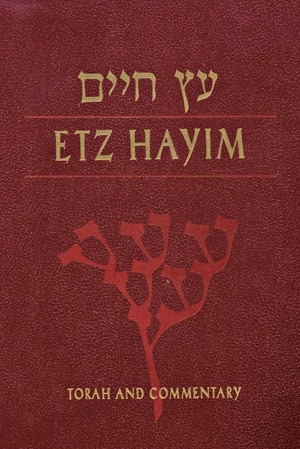 Upon recently attending the bat-mitzvah of one of my closer relatives, I had the unique opportunity to read through a number of commentaries offered by JTS in their most recent addition of the Etz Chayim Chumash. Additionally, I was able to analyze the essays printed in the appendix which attempt to explain the theological foundations of the movement. However, a number of inherently contradictory positions concerning the origins, role and importance of the written and oral law left me not only confused but restless for the remainder of that Shabbat.
Enclosed is an article which analyzes the Conservative Movement's approach to P'shat, Drash and Halacha as stated in their publications and public announcements. From a purely intellectual standpoint, I found myself having been confused with the same inherently contradictory positions enumerated in the Conservative Movement's writings. While I did find this essay a unabashed in its critique of the Conservative movement's pillars of faith, I must agree that the degree of self-contradiction in Etz Chayim is baffling to all who take it seriously.
For the sake of convenience, I have taken the liberty of highlighting what I'd consider to be the main points of the article.
Article Link: Etz Chayim and the Conservative Movement
Thursday, March 8, 2012
Wednesday, March 7, 2012
Tuesday, March 6, 2012
Monday, March 5, 2012
Sunday, March 4, 2012
Friday, March 2, 2012
An Insightful Shidduch Resume?
 Recently, I was asked to put together my own shidduch resume before being able to see a girl who was recommended for me. Personally, I consider the whole business silly. Please remind me again what insight a mere two pages can provide into the vastly vibrant and ornamented corridors of a human soul?
At least to me, each resume seems to appear identical. Everyone wants the same things, has the same middos, has essentially compatible hashkafos and basically went to the same schools/camps. So what exactly might we be attempting to transmit with the swapping of this info?
Off the top of my head, Click Here To Read More
Subscribe to:
Posts (Atom)